Information
Testament of Solomon
The Testament of Solomon is a pseudepigraphical composite text ascribed to King Solomon but not regarded as canonical scripture by Jews or Christian groups. It was written in the Greek language, based on precedents dating back to the early 1st millennium CE, but was likely not completed in any meaningful textual sense until sometime in the Middle Ages. In its most noteworthy recensions, the text describes how Solomon was enabled to build his temple by commanding demons by means of a magical ring that was entrusted to him by the archangel Michael.
Images of Solomon's Seal or Ring of Solomon:
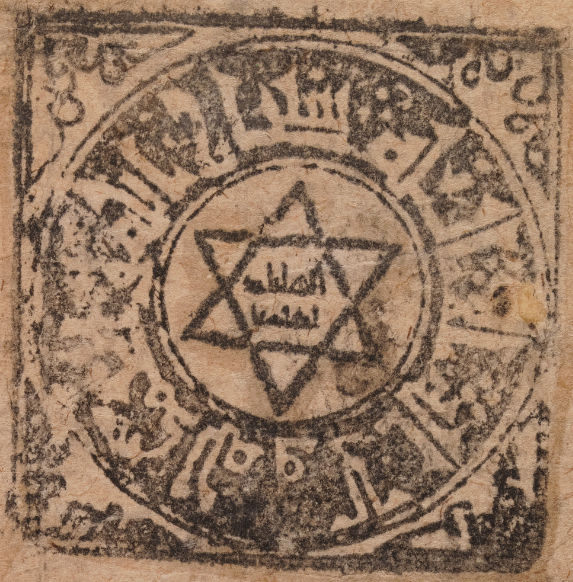

Although it can, in some images, resemble what we would call today a "Pentagram", it is very fascinating that this could of been the seal Solomon would have used to capture and control demons. Which makes alot of sense considering satanists use this in their rituals to release or harness the power of demons. This seal could have very well been the reason a pentagram is used today for satanic rituals. It is more traditionally described as a six sided star.
Note from Wikipedia: The representation as a pentagram, by contrast, seems to arise in the Western tradition of Renaissance magic (which was in turn strongly influenced by medieval Arab and Jewish occultism); W. Kennett (1660-1728) makes reference to a "pentangle of Solomon" with the power of exorcising demons.
An interesting footnote story: "Solomon is represented as having authority over spirits, animals, wind, and water, all of which obeyed his orders by virtue of a magic ring set with the four jewels given him by the angels that had power over these four realms. [...] It was Solomon's custom to take off the ring when he was about to wash, and to give it to one of his wives, Amina, to hold. On one occasion, when the ring was in Amina's keeping, the rebellious spirit Sakhr took on Solomon's form and obtained the ring. He then seated himself on the throne and ruled for forty days, during which time the real king wandered about the country, poor and forlorn. On the fortieth day, Sakhr dropped the ring into the sea; there it was swallowed by a fish, which was caught by a poor fisherman and given to Solomon for his supper. Solomon cut open the fish, found the ring, and returned to power. His forty days' exile had been sent in punishment for the idolatry practiced in his house for forty days, although unknown to him, by one of his wives"
Psalms of Solomon
From: The Forgotten Books of Eden, by Rutherford H. Platt, Jr., 1926
This collection of eighteen war songs are the gift of an ancient Semitic writer. The original manuscript has perished but fortunately Greek translations have been preserved, and recently a Syriac version of the same songs has turned up and was published in English for the first time in 1909 by Dr. Rendel Harris.
The date of the writing may be established at the middle of the First Century B. C. because the theme of these songs is that of Pompey's actions in Palestine and his death in Egypt in 48 B.C.
These psalms had an important position and were widely circulated in the early Church. They are frequently referred to in the various Codexes and histories of the first few centuries of the Christian Era.
Later, they became lost through inexplicable reasons; and have only been recovered for our use after the lapse of many centuries.
Besides the literary value of the trumpet-like rhythm of these verses, we have here a chapter of stirring ancient history written by an eyewitness. Pompey comes out of the West. He uses battering-rams on the fortifications. His soldiers defile the altar. He is slain in Egypt after a fearful career. In the "righteous" of these psalms we see the Pharisees; in the "sinners" we see the Sadducees. It is an epic of a great people in the throes of a great crisis.
Odes of Solomon
From: The Forgotten Books of Eden, by Rutherford H. Platt, Jr., 1926
Here are some of the most beautiful songs of peace and joy that the world possesses. Yet their origin, the date of their writing, and the exact meaning of many of the verses remain one of the great literary mysteries.
They have come down to us in a single and very ancient document in Syriac language. Evidently that document is a translation from the original Greek. Critical debate has raged around these Odes; one of the most plausible explanations is that they are songs of newly baptized Christians of the First Century.
They are strangely lacking in historical allusions. Their radiance is no reflection of other days. They do not borrow from either the Old Testament or the Gospels. The inspiration of these verses is first-hand. They remind you of Aristides' remark, "A new people with whom something Divine is mingled." Here is vigor and insight to which we can find parallels only in the most exalted parts of the Scriptures.
For these dazzling mystery odes, we owe our translation to J. Rendel Harris, MA., Hon. Fellow of Clare College, Cambridge. He says about them: "There does not seem to be anything about which everyone seem agreed unless it be that the Odes are of singular beauty and high spiritual value."
Historical seal illustrations depict two-dimensional art and a geometric seal. Introduction includes material from Wikipedia contributors, Testament of Solomon and Seal of Solomon, CC BY-SA 4.0; formatting adapted.
Start reading →